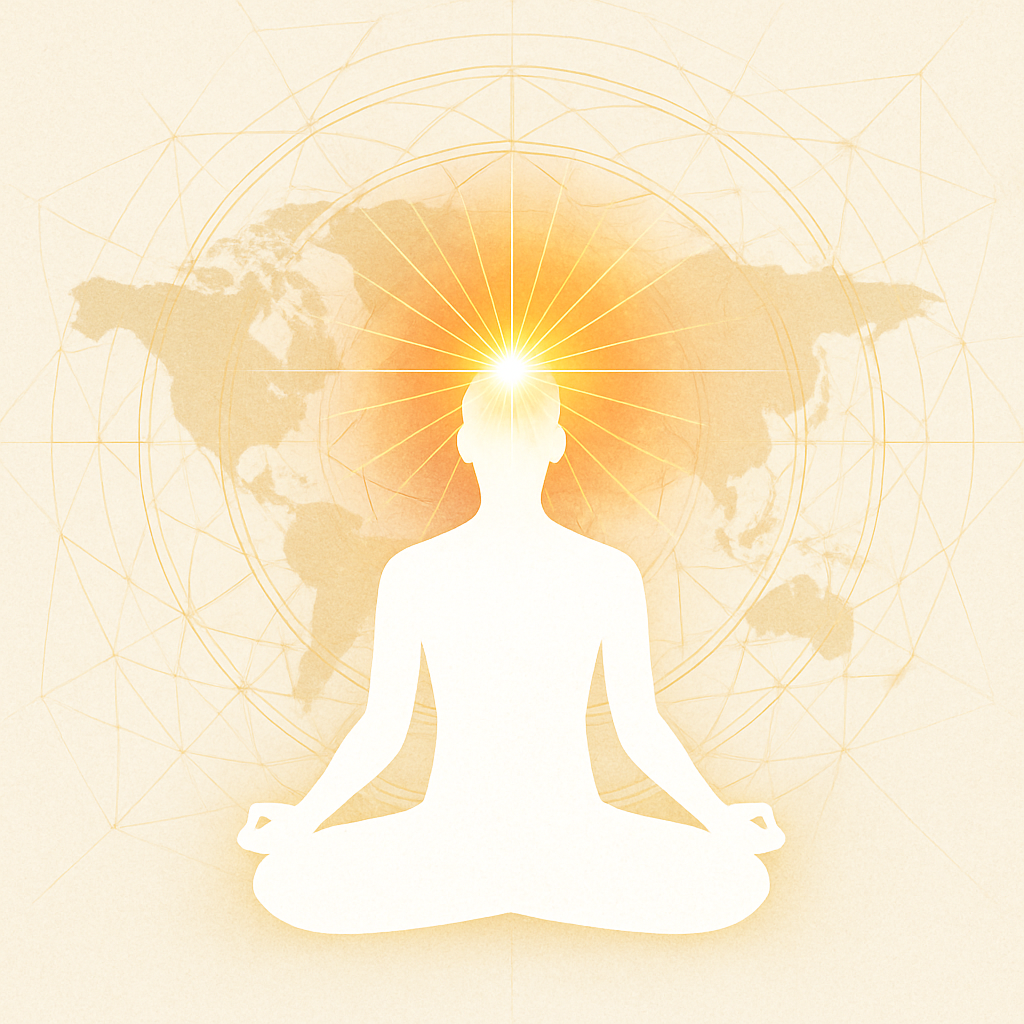
Brahma Kumaris (BK) spiritual philosophy teaches that each person’s true identity is an eternal soul – “a sparkling tiny point of light”[1] – distinct from the transient physical body. The soul is described as incorporeal, changeless and timeless, endowed with inherent qualities like peace, purity, love, knowledge and bliss[1]. In this view, souls originate in a sublime spiritual realm called Paramdham (or Brahmlok), the “supreme abode” of light, and periodically descend to Earth to play their part on the world stage[2][3]. Life on Earth is seen as an eternal “world drama”: a grand, cyclical story (of about 5000 years) in which souls enact roles through successions of births. As one BK source explains, “the World Drama is the story of human souls, our rise and fall, victory and defeat, happiness and suffering, wisdom and ignorance”[4]. Each cycle unfolds from an original Golden Age to a declining Iron Age and back, in a repeated day-night pattern of progress and decay[5].
This article examines the BK perspective on soul consciousness and the soul’s descent into this world drama, framing it as a complete conceptual system. We will then draw parallels to Oswald Spengler’s Decline of the West, comparing BK’s cycle of civilization to Spengler’s view of cultural rise-and-fall, and finally argue why these ideas – far from being sectarian – are offered as universal insights with implications for global peace.
Problem Statement
Brahma Kumaris teachings hold that many of today’s global and civilizational problems stem from a loss of spiritual powers to consciousness. In the BK analysis, most people identify with the body and material success instead of the soul. This “body consciousness” breeds vices like lust, anger, greed and ego, leading to personal suffering and social conflict[6]. Inner emptiness and uncontrolled desires generate the “discontent and seeking” that fuel crime, war and environmental abuse. One commentator summarizes: “lack of [soul] awareness is the root cause of suffering, conflicts and war” both within individuals and among nations[7]. In other words, BK asserts that spiritual ignorance underlies aggression, injustice and division. By contrast, cultivating soul consciousness – awareness that we are souls of light – is said to restore our innate virtues and quell the impulses behind violence[8][6].
However, this framework also has limits. The BK approach addresses psychological and ethical dimensions of crises (inner discord, hostility, loss of meaning) rather than prescribing specific technical or material solutions. For example, knowing one’s soul does not directly fix poverty, disease or political disputes in a mechanical sense. Instead, BK philosophy claims that meaningful world peace can only come once people fundamentally change their consciousness. Thus the problem statement here is: Modern global decay (violence, social breakdown, environmental harm) is viewed as arising from a decline in human soul-consciousness. This knowledge purports to address the root consciousness-crisis behind these problems, though it does not replace the need for practical measures on material issues.
Conceptual Framework
Soul consciousness vs. body consciousness. At the core of the BK view is the distinction between identifying as a soul (atma) versus identifying as a body. Soul consciousness means knowing one’s “true essence” beyond physical form[8]. When fully soul-conscious, we naturally express our inherent qualities (peace, purity, love, wisdom, bliss, joy, power, ). By contrast, body-consciousness – seeing ourselves only as bodies and roles – is said to generate negative traits (anger, greed, fear) in search of external satisfaction[6]. The transition from body- to soul-consciousness is gradual and requires meditation and self-awareness. For example, Raja Yoga meditation as taught by BKs involves visualizing oneself as a point of light and connecting mentally to the Supreme Soul (God). This practice “cleanses the soul of negative impressions” and strengthens the awareness that “I am a peaceful soul”[9][10].
Descent from Paramdham and the World Drama. In BK cosmology every soul originates in Paramdham – a “dead-silence” world of divine light – and descends into the earthly drama to enact predetermined roles[2][3]. According to one source, “the soul…resides in Paramdham, its heavenly abode. Every soul descends on earth to play a part in the eternal world drama.”[3]. Upon descent, a soul receives a “space suit” (a human body with five senses) to experience life[11]. Souls then live a sequence of lives (“serials”) on Earth, each with its assigned role according to a divine script[12]. The soul itself remains unchanged – like an actor who stays the same person even as costumes change – and is essentially a silent witness behind its role[13][12]. In this metaphor, every character’s thoughts and emotions vary with the script, but the underlying soul (the “I” within) is a constant observer[12][13].
Combination of powers and soul roles. Brahma Kumaris teachings describe souls as having different “powers” or virtues. In the Golden Age of the cycle, souls are said to possess all divine qualities. For instance, about 900,000 initial souls in the Golden Age are described as “perfect with powers and virtues…16 celestial degrees complete with all virtues and powers”[14]. In practical terms, this means souls have inherent purity, wisdom and spiritual capabilities. Over the cycle, as the drama progresses through Silver, Bronze and Iron Ages, souls gradually lose these powers under the weight of ego and vice. This decline makes souls less virtuous in each age (from sixteen to fourteen degrees in the Silver Age, etc.[14][15]).
Each soul’s role in history is linked to its level of virtues and deeds. These roles play out “as per the recording in the soul” or cosmic karma[16]. In other words, every soul has a unique “vector position” in the cycle – a fixed orientation in the space-time of the world drama determined by its past actions and innate nature. Divine order is seen in the overall script: while individuals have freedom within their roles, God is understood as the supreme director who periodically intervenes to reset the cycle and re-establish order (for example, the doctrine holds that a divine incarnation appears at the cycle’s nadir to renew spiritual values). Throughout, BK emphasizes that God and soul together maintain the world-play: Only the role is played out as per the script of drama.”[12].
Parallels with Spengler’s Decline of the West
The BK cosmology of cyclical rise and fall bears interesting parallels to Oswald Spengler’s philosophy of history in The Decline of the West. Spengler famously argued that each great culture or civilization follows an organic life-cycle – from birth (spring), growth, maturity (summer), to decay and death (winter) – much like an individual human life. As Spengler puts it: “Every Culture passes through the age-phases of the individual man. Each has its childhood, youth, manhood and old age.”[17]. This matches the BK idea of ages (Satya, Treta, Dwapar, Kali) within a larger cycle, with the early phases characterized by spiritual vigor and later phases by degeneration.
Spengler paints the final “winter” stages as spiritually empty. He describes declining cultures as becoming “unspiritual, unphilosophical, devoid of art… clannish to the point of brutality, aiming relentlessly at tangible successes”[18]. Similarly, BK teaching characterizes the Iron Age as an “ignorance night” where souls plunge into vices and conflict. In both views, late-stage society turns materialistic and cynical, having lost the higher values that inspired its earlier greatness. Spengler even dramatizes this loss in phrases like “in the grey dawn of Civilization, the fire in the Soul dies down”[19], echoed in BK literature by the fading of divine qualities.
Thus, Spengler’s civilizational decay mirrors the BK picture: humanity moves through a cyclical moral spiral. In Spengler’s terms, the West in the modern era is in its final “old age,” a time of unquestioned rationalism and dilution of spiritual sense. This is analogous to how BK narratives describe the current “Iron Age” as a twilight of virtue (preceding a divinely orchestrated renewal). Both perspectives stress that historical decline is not random but inevitable without a deeper awakening. BK explicitly sees this cycle as culminating in spiritual crisis – “lack of [soul] awareness” – rather than mere external causes[7], which resonates with Spengler’s diagnosis that the decline is a “philosophical problem” implicating “every great question of Being”[20].
Universal Applicability
Although rooted in a specific spiritual tradition, the BK teaching on soul and cycles is presented as universally relevant. Its language is framed philosophically: the notion of an immortal soul is recognized across many cultures (for example, the article The Concept of Soul in Brahmakumaris notes that the idea of an eternal soul “is present in various religious and philosophical traditions”[21]). BK literature goes further to emphasize that all souls are fundamentally the same. One commentary insists “all souls belong to one God… Therefore, all souls are brothers,” insisting on an underlying unity of humanity[22]. This echoes the traditional ideal of vasudhaiva kutumbakam (“the world is one family”) and is explicitly promoted by the movement: BKs themselves claim to have propagated the idea of “one world, one family” in service of global peace[23].
Moreover, the path of inner transformation is not presented as an exclusive ritual or dogma. BK teachings sidestep sectarian labels, focusing instead on practical self-change (meditation, awareness) that anyone can undertake. The assertions about the soul’s qualities and descent are offered as metaphysical insights rather than claims to secret revelation. Indeed, one publication notes that BK’s soul-view “is in tune with the Greek notion of soul” and similar to Eastern concepts of ātman, identifying the soul as the “essential self” and “silent observer”[24]. This suggests that BK ideas have analogues in other philosophies (Hindu, Buddhist, Platonic, etc.), strengthening the claim of universality.
In sum, the BK framework is meant to be inclusive: it posits a single Creator (Shiva) and declares that all of us are “brothers in relation,” not divided by creed or caste[25][22]. By grounding ethics and peace in the shared spiritual identity of humanity, the BK perspective is argued to transcend particular religions. Its promoters point out that these teachings have been spread worldwide (in 140+ countries[23]) with a view toward harmony for all people.
Conclusion
The Brahma Kumaris narrative of soul consciousness and the cyclical world drama is presented as a complete alternative worldview for understanding and solving the crises of our time. Its claim – that only by awakening to our true nature as souls can humanity escape repeating cycles of decay – is a bold philosophical stance. From this perspective, current social and moral breakdown is not merely a political or economic problem but a symptom of profound spiritual forgetting[7]. The BK solution, therefore, is likewise spiritual: a disciplined shift inward, to re-identify with the soul’s virtues and God’s light. In practice, this means cultivating empathy, purity and inner peace in everyday life.
Such an approach is asserted to be the only sustainable path to world peace. The reasoning is that conventional efforts at peace and progress have ignored the human psyche’s deeper currents: unless people change from within, any treaty or law will at best be temporary. This view resonates with Spengler’s warning that the West is in a phase of moral exhaustion[19]. It also extends Spengler’s cyclicism: if history’s decline is inevitable in material terms, then renewal must come from a transcendent source. BK teaching explicitly names that source and strategy – divine guidance and soul consciousness. In conclusion, proponents argue that by reviving our inner connection to the “unlimited” (the soul and God), we align with a higher, cyclical order of history. Only then, they contend, can humanity break free of the downward spiral and realize genuine, lasting peace.
Sources: Brahma Kumaris literature and related commentary[2][4][8][6][3][12][22][1][7]; Oswald Spengler, The Decline of the West[20][17][19][18].
[1] [3] [7] [11] [12] [13] [16] [21] [22] [23] [24] tijer.org
[2] [25] Our Relationship with God (the Supreme Soul)
[4] [5] [14] [15] World Drama Cycle » Brahma Kumaris
[6] [8] [9] [10] Understanding Soul Consciousness » Brahma Kumaris
[17] [18] [19] [20] The Decline of the West| Project Gutenberg
Leave a Reply