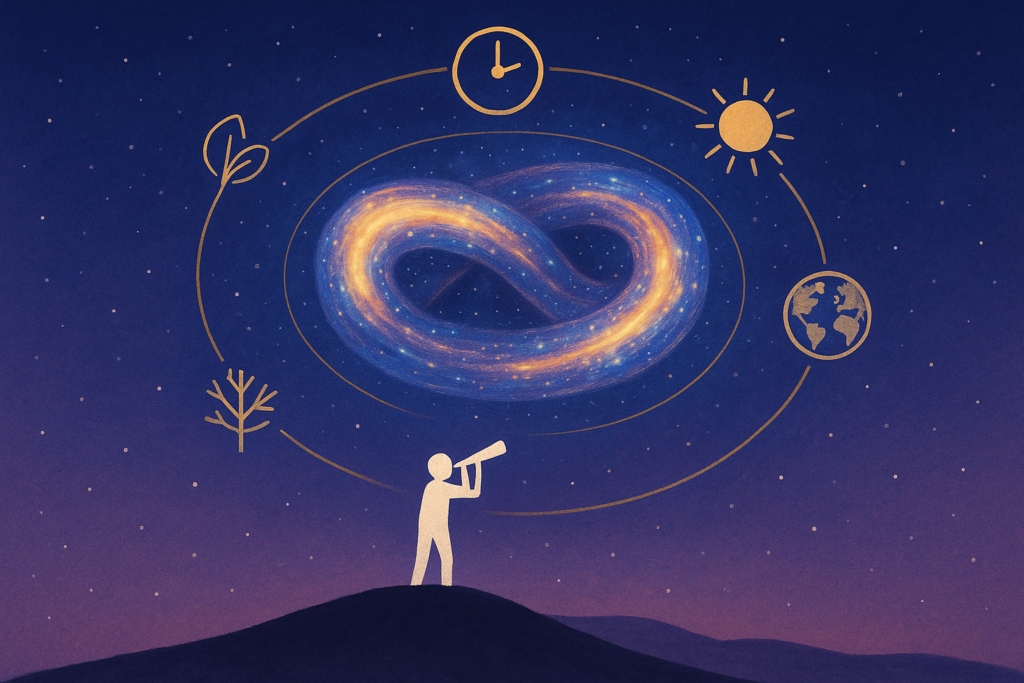
Modern physics has achieved great successes in explaining the universe at both the cosmic and microscopic scales. The Standard Model of particle physics describes fundamental particles, and General Relativity describes gravity on cosmic scales. However, key mysteries remain unsolved. For instance, why is the universe expanding the way it is, with a mix of ordinary atoms, dark matter, and radiation? As noted by astrophysicist Martin Rees, “Many key questions still remain to be answered, like why the Universe is expanding the way it is and why it contains a mix of atoms, dark matter and radiation.”[1]. We still do not know what dark matter and dark energy actually are, only inferring their presence from gravitational effects and cosmic acceleration. Current theory also fails to unify quantum mechanics with gravity – we lack a quantum theory of gravity, so in extreme conditions like black hole cores, the known laws of physics “break down”[2]. The very singularity at a black hole’s center is a region where Einstein’s equations predict infinite density, signaling that new physics is needed.
Another open question is whether there is a deeper connection between scales in the universe. Physics treats atomic, stellar, and galactic systems as separate realms, each with its own laws or models, yet nature exhibits striking hierarchical structure. Indeed, the cosmos is nested: “From elementary particles to superclusters of galaxies we see parts collected to form wholes, and the latter into larger wholes, and so on.”[3]. Atoms form stars, stars gather in galaxies, galaxies cluster into larger structures. Self-similarity is common in nature’s patterns (think of repeating shapes in ferns, coastlines, or clouds[4]), so it is intriguing to ask if nature as a whole might be fractal or self-similar across scales[5].
Historically, scientists noticed an analogy between atoms and solar systems. Rutherford’s early 20th-century model of the atom pictured a tiny heavy nucleus at the center with electrons orbiting around it – “much like planets revolving around the Sun”[6]. In this analogy, the nucleus is like the Sun and an electron is like an orbiting planet[7]. This planetary model of the atom successfully explained why most of an atom’s mass is concentrated in a small core[8]. However, classical physics predicted that electrons would spiral into the nucleus (as orbiting planets would eventually fall into the Sun if they radiated energy). Quantum mechanics solved this by quantizing electron orbits[9], abandoning the idea of literal planet-like paths. Thus, modern physics moved away from a literal solar system model of atoms because of quantum behavior. Nevertheless, the structural analogy – a central massive object with satellites – persists as a curious pattern at multiple scales.
In summary, current theories leave several gray areas. We lack answers to fundamental questions about the universe’s composition, origins, and the unity of forces. We observe that nature is organized in a hierarchy (atoms → stars → galaxies), yet we don’t know if this is just a coincidence or hinting at a deeper principle. These open issues motivate exploring new models that might provide a more complete and unified picture.
A New Hierarchical Model: Central Black Holes at Every Scale
One bold proposal is a hierarchical model of the universe in which similar structures repeat at different scales, each centered on a “central black hole” or analogous massive core. In this model, every level of organization has a massive central object playing a role similar to the Sun in our solar system (or a nucleus in an atom), with smaller bodies orbiting or surrounding it (analogous to planets or electrons). The idea posits a kind of cosmic “Russian doll” hierarchy: from atomic nuclei up through solar systems and galaxies, each system is structured around a dominant central mass.
An artist’s conception of a supermassive black hole (black dot at center) within a young galaxy. In the proposed hierarchy, such central black holes at galactic cores are analogous to the central stars of solar systems or even to atomic nuclei[10][6]. Each level of the cosmos may share this organizing principle of a massive core with orbiting constituents.
At the galactic scale, this model starts with an observational fact: most galaxies (including our Milky Way) harbor a supermassive black hole at their center[11]. The stars in a galaxy orbit not just an unseen dark matter halo but also the central black hole in the galactic nucleus. For example, observations of quasars revealed that “the energy source for these quasars was a massive black hole located in the centre of the galaxy”[11], gravitationally powering the quasars’ immense luminosity. In our own Milky Way, stars like S2 have been seen whipping around an invisible object at the center – Sagittarius A – which has been confirmed as a 4-million-solar-mass black hole. Thus, the notion of a central gravitational anchor* at the galaxy’s heart is well-established.
Zooming in to the stellar scale, the analogy suggests that stars themselves might contain (or effectively behave like) tiny black holes at their core. This is a far more speculative idea – the Sun is not a black hole in standard astrophysics – but the new model postulates a continuity of structure: the Sun is to the solar system what a black hole is to a galaxy. Some researchers have indeed entertained this provocative idea. For instance, physicist Nassim Haramein’s unified physics model proposes that “all stars contain black holes at their cores.”[12] In this view, a star like our Sun could harbor a small black hole or a “gravitational singularity” at its center, which might drive certain phenomena. Interestingly, there have been puzzling observations (such as unexpected gamma-ray emissions from the Sun[13]) that inspired questions about whether something exotic lies at the Sun’s core. While mainstream science explains the Sun’s energy by nuclear fusion (no black hole needed), the hierarchical model dares to imagine the Sun’s core as an analogue of a galactic nucleus – effectively a tiny black hole sustaining the system’s structure. Recent studies of enigmatic stellar objects also hint that “black hole stars” might exist (stars formed around a black hole seed), lending some indirect credence to the idea that black holes can reside in stars[14][15].
Going further down in scale, the model draws an analogy between solar systems and atoms. Each atom has a massive, positively charged nucleus at the center and electrons bound around it. In the hierarchy model, the atomic nucleus would correspond to a minuscule “black hole” in the same conceptual sense – a dense core that holds the atom together. Indeed, some theorists have treated elementary particles as tiny black holes to explore unification of forces. Haramein, for example, argued that a proton can be viewed as a tiny black hole if one considers the vacuum energy density inside it. By his calculations, only an incredibly small fraction (~10^(-39)) of the vacuum’s energy within a proton volume would need to become coherent to gravitationally bind the proton like a Schwarzschild black hole[16][17]. In this picture, a “Schwarzschild proton” has just enough mass-energy (from the seething quantum vacuum) to meet the conditions of a microscopic black hole – essentially treating the strong nuclear force as gravitational attraction between such micro-black-holes. While this is a radical departure from conventional quantum chromodynamics, it exemplifies the hierarchical model’s core idea: the same underlying phenomenon (gravity/black holes) might be present from the atomic scale up to galaxies.
This hierarchical view suggests a fractal or self-similar universe. Each “layer” – atoms, stellar systems, galactic systems – follows the same organizing principle: a central concentrated mass with a surrounding structure. The Sun-Earth system is a specific case (star and planet), but at each higher or lower level we find analogous pairs: a galaxy and its central black hole, an atom and its nucleus (or perhaps nucleons and quark cores). Even phenomena like accretion disks or rings appear at multiple scales: galaxies have spinning disks of stars, stars can have accretion disks or planetary disks, and even atoms have electron “clouds” that, in a loose analogy, resemble diffuse orbiting shells. The repetition of patterns is reminiscent of self-similarity in fractals – much like how a small piece of a fern leaf resembles the whole fern, a solar system might resemble a miniature galaxy, and an atom a miniature solar system.
To visualize this, consider analogies in nature: A hurricane’s spiral structure and rotation curve eerily mirror those of a spiral galaxy, both exhibiting a calm center (the eye vs. the galactic core) and circulating “arms” (storm bands vs. spiral arms) – a coincidental similarity in appearance and rotation profile[18]. In fluid dynamics and astrophysics, vastly different scales produce disk-like, orbiting systems (from water swirling down a drain, to planetary rings, to galactic disks). The hierarchical model suggests these similarities are not just superficial but stem from a common physical principle manifesting at different scales.
Crucially, the model is hierarchical: it implies layers of “universes within universes.” One can imagine that an atom might contain, at its core, a micro-universe of its own (if the nucleus were a black hole), and conversely our entire observable universe might itself be the interior of a colossal black hole in a larger cosmos. In fact, applying the equations of General Relativity to the universe as a whole is suggestive – the mass density of the observable universe is such that the Universe’s radius is comparable to its Schwarzschild radius. In other words, “the mass of our universe exceeds the mass needed to overcome the escape velocity of light” – essentially our universe meets the criteria to be a black hole in a higher-dimensional space[10]. This intriguing result implies our Big Bang might have been a “white hole” emergence from a black hole in a parent universe, dovetailing with ideas like black hole cosmology or “fecund universes” hypothesis. Every black hole may contain a new universe, and every universe may eventually spawn new black holes – a hierarchical tree of universes.
In summary, the proposed Central Black Hole Hierarchy model asserts that at every major scale break in the structure of matter, there is a central gravitational entity analogous to a black hole (or literally a black hole) that organizes the system. Galaxies orbit supermassive black holes, solar systems orbit stars (possibly powered by black-hole-like cores), atoms orbit nucleus-like singularities. The same physics and geometry repeat, scaled appropriately. It is a sweeping vision that unifies the cosmic and the quantum by treating them as self-similar systems.
Answering Fundamental Questions with a Fractal Black Hole Model
Why pursue this unconventional model? Because it offers potential answers to many unanswered questions in current science, making it a compelling alternative to prevalent theories. By positing a unifying principle across scales, the hierarchical black hole model can address those gray areas and puzzles:
- Unification of Forces and Scales: In standard physics, gravity is incredibly weak compared to other forces at the atomic scale, and we have separate theories for quantum forces versus gravity. The new model bridges this gap by suggesting gravity (in the form of tiny black holes) might be the source of nuclear binding. For example, if protons are treated as tiny black holes, their mutual gravitational attraction (augmented by vacuum energy effects) could mimic the strong nuclear force that holds atomic nuclei together[17][19]. One paper showed that the hypothetical “Schwarzschild proton” could account for the strong force magnitude without invoking a new force, simply through gravity at the Planck scale[19]. This approach, though speculative, unifies the micro and macro: gravity isn’t irrelevant to atoms, it’s central. Thus, quantum scale objects and cosmic objects might follow the same laws, finally linking quantum mechanics and gravitation in principle. A single framework (black hole physics) describes everything from protons to galaxies[20][21]. Such scale-invariance is a step toward a long-sought Theory of Everything, embedding quantum phenomena within a gravitational (or geometric) context.
- Solution to the Dark Matter Mystery: The hierarchical model provides an elegant explanation for dark matter – one of the biggest astrophysical puzzles. In a self-similar cosmos, there should exist “analogues” of particles at larger scales, potentially in the form of numerous small black holes. Astrophysicist R.L. Oldershaw, who explored discrete self-similarity in nature, predicted that galaxies should be “teeming with ultra-compact objects (black holes) of about 10^(-5) to 0.1 solar masses” as macroscopic analogues of electrons and protons[22]. Remarkably, such masses fall right into the range of the mysterious MACHOs (Massive Compact Halo Objects) that astronomers once considered for dark matter, and early gravitational microlensing experiments did find hints of objects around ~0.1 solar mass in galactic halos[23][24]. The fractal model “leads naturally and unequivocally to the prediction that the observed, but enigmatic, dark matter is primarily composed” of those very black hole-like entities[22]. In other words, dark matter could be made of a sea of “failed stars” or microscopic black holes that are the scaled analogues of subatomic particles. This neatly ties the dark matter problem to the hierarchy – it isn’t mysterious new particles at all, but an overlooked population of black holes which the model inherently expects. Such an answer is highly economical: it doesn’t require modifying gravity or conjuring exotic new particles, just recognizing a new level in the cosmic hierarchy. As observational evidence, if future surveys confirm large numbers of planet-mass to small-star-mass black holes drifting in galaxies’ outskirts, it would strongly support this view[25][22].
- Demystifying Dark Energy and Cosmic Expansion: In the hierarchical orbital model, the universe is never singular and never “born” from a one-time Big Bang. Instead of an initial explosion from nothing, the cosmos is taken to be an eternal, self-sustaining orbital system at every scale. Large structures (galaxies, clusters, super-clusters) move in long-period trajectories within a deeper gravitational architecture, just as planets move in orbits within a solar system. What we interpret today as a uniform “expansion of space” and “cosmic acceleration” is then re-read as the kinematics of these enormous orbital motions observed from our particular location and phase in the cycle. There is no need for a beginning-of-time singularity or a mysterious dark-energy fluid that switches on only in the late universe; the cosmos is permanently dynamic, with regions that, at different epochs, can appear to be speeding up, slowing down, or roughly steady, exactly as a planet’s speed varies along its orbit even though the underlying motion is closed and eternal. In this view, “infinity” is not an abstract mathematical trick but a direct consequence of the universe never leaving its grand orbital dance: it has always existed in motion and will continue to do so, cycling through configurations without a first or final moment.
- Cosmic Structure and Fine-Tuning: The model naturally explains why certain dimensionless numbers appear across scales. For example, why do galaxies and atoms share similar stable configurations (orbiting bodies, disks, etc.)? In a fractal cosmos, this is expected because “cosmological self-similarity implies analogous physics on all observable scales”[27]. It is not a coincidence but a consequence of self-organization. The model even predicts specific scaling ratios – one implementation found that the size ratios between atoms, stars, and galaxies might be roughly constant (on the order of 10^17 difference in scale)[28][29]. Such regular scaling could hint that the laws of physics repeat with a set scaling factor, which, if confirmed, speaks to an underlying simplicity in the apparently arbitrary sizes of things. Moreover, by treating all scales with similar equations, the model might address the fine-tuning problem (why fundamental constants have the values they do): those constants might be emergent from geometry that spans multiple scales, not fixed inputs. In short, the hierarchy model aspires to reveal a grand design where now we see only fragmented pieces.
- New Predictions and Explanations: A strength of any theory is the ability to make testable predictions. The hierarchical black hole model, being unorthodox, suggests many. It predicts, for instance, that we should discover unusual objects: black holes of intermediate scale (e.g. the mass of heavy planets or brown dwarfs) that don’t fit normal stellar evolution – essentially the hidden “particles” of the stellar scale. There is already some evidence: gravitational lensing surveys have indeed detected unexplained microlensing events consistent with planetary-mass or substellar black holes floating in galactic halos[30][24]. The model also predicts certain relationships, such as a tight correlation between the mass of a galaxy’s central black hole and the galaxy’s properties (which observational astronomy has confirmed – black hole mass correlates with galaxy bulge mass). It even intriguingly predicts that protons might have tiny differences from what the Standard Model says if gravity contributes at that scale – for example, there could be a slight discrepancy in the strong force at certain distances that might one day be observed. While these ideas are speculative, they show the model is falsifiable: evidence of self-similar scaling in nature (or lack thereof) can support or refute it. As one proponent argued, the self-similar model “can make definitive predictions and point to actual observational support”, and if its distinctive mass predictions for dark matter objects are verified, it would warrant serious acceptance[31][32].
- Conceptual Coherence: Beyond empirical questions, the new model offers a compelling narrative that many find philosophically satisfying. It paints a universe where nothing is isolated – each atom is a miniature cosmos, and our cosmos might be an atom in a vast super-cosmos. This “worlds within worlds” vision[33] removes the artificial distinction between the very large and the very small. It implies an infinite or at least very large continuum of scales, erasing the need to think of the universe as having an “edge” or singular boundary at the Big Bang or at the Planck length. Such continuity could answer why our laws of physics are the way they are: they might be inherited from a larger-scale structure. It also reframes our place in the universe – we might literally be inside a black hole, and every time a black hole forms in our universe, a baby universe sprouts. While this sounds extravagant, it actually conserves explanatory principles (using the same idea repeatedly) rather than introducing many unrelated ones. It resonates with a sense of cosmic symmetry and recursion that is appealing if true.
Of course, it must be acknowledged that this hierarchical black hole model is still a hypothesis outside the mainstream. It challenges well-established paradigms (for example, conventional stellar physics would scoff at a black hole inside the Sun). Skepticism is healthy, and much work is needed to formalize these ideas into quantitative theories that match all known data. Not every analogy means identical physics – a hurricane isn’t actually a galaxy, and an atom isn’t literally a solar system in miniature; there are important differences. But as Albert Einstein remarked, “It has often happened in physics that an essential advance was achieved by carrying out a consistent analogy between apparently unrelated phenomena.”[34] The self-similar hierarchy could be one of those bold analogies that leads to an “essential advance” in our understanding. By pursuing the hints of similarity across scales, scientists may discover a deeper unity in nature’s laws that current theories have overlooked.
In conclusion, this central black hole hierarchy model addresses basic questions about the universe in a more comprehensive and convincing way (at least in principle) than the patchwork of current theories. It tackles the “grey areas” left by the Big Bang model, dark matter conundrum, and quantum-gravity divide by positing a coherent framework where each scale mirrors others. It is assertive in its claim that the same engine drives everything: black holes – whether microscopic or supermassive – are the key organizing structures of matter and space. This bold idea not only opens new research directions (from searching for microscopic black holes to re-examining atomic physics), but it also fuels the imagination with rich analogies. Like an onion with infinite layers or a set of nested dolls, the universe may contain worlds within worlds, each governed by familiar dynamics. What the prevalent theories describe as separate domains may actually be chapters of one grand story, with the humble “sun and earth” pattern repeating from the tiniest atom to the vastest galaxy. By recognizing and exploring this hierarchy, we move closer to a unified understanding of the cosmos – one that satisfies both the physicist’s quest for deep consistency and the non-technical reader’s sense of wonder at the elegant tapestry of nature.
Sources:
- Rees, M. (2023). The unanswered questions about the universe. Interview – IntellectInterviews[1][11].
- Lancaster University (2021). How physics breaks down in a black hole. Phys.org[2].
- Oldershaw, R.L. (1994). A fractal universe? Self-similarity in nature[3][34].
- Britannica. Rutherford’s atomic model. (2025)[6][7][9].
- Haramein, N., et al. (2010). Scaling law for organized matter: Schwarzschild proton and unified physics. Proceedings of Unified Theories[16][19].
- Haramein’s model in media: Physicist claims stars have black holes at core. ISF / SpaceFed (2023)[12][14][13].
- Oldershaw, R.L. (1992). Discrete self-similarity and dark matter. Astrophysical Journal (predictions for MACHOs)[22][24].
- Haramein, N. & Rauscher, E.A. (2008). Universe as a black hole. (Conference paper)[10].
- MACHO Collaboration (1993–1998). Microlensing results. (Referencing dark matter objects)[23][25].
- Einstein, A. (1933). Quoted in[34] on the power of analogies in physics.
[1] [11] Martin Rees | The Unanswered Questions about the Universe –
[2] How physics breaks down in a black hole
[3] [4] [5] [22] [23] [24] [25] [26] [27] [28] [29] [30] [31] [32] [33] [34] A Fractal Universe?
[6] [7] [8] [9] Rutherford model | Definition, Description, Image, & Facts | Britannica
[10] [16] [17] [18] [19] [20] [21] (PDF) A SCALING LAW FOR ORGANIZED MATTER IN THE UNIVERSE
[12] [13] [14] [15] “Black Hole Stars” Detected at Cosmic Dawn – The International Space Federation (ISF)
Leave a Reply